
Start a trip.
Open Ryokōya before you set out. Give it the location permissions it needs, then put your phone in your pocket.
For the curious. For iPhone.
A travel journal that lets you be there.
Start a trip, put your phone away, and come back to your route, your stops, your day.
Free journaling. Optional Pro features and city packs.
Why it exists
You land somewhere you have never been and you do the right thing: you walk out with no plan. A courtyard you did not mean to find. A counter with six seats and a menu you cannot read. A bridge, a bookshop, a bar where the barman writes your name on the tab in chalk.
Then you are back at the hotel with your shoes off, and someone asks where you went. And what you have is: a street beginning with V. Somewhere near the water. The one with the blue door.
That is not a bad memory — it is what a new city does to everybody. Names do not stick because nothing around them is familiar yet. At home you would hang the day on the dentist and the number 14 bus. Here there is nothing to hang it on, and by the time you are home the whole week has quietly become “that trip where we walked a lot.”
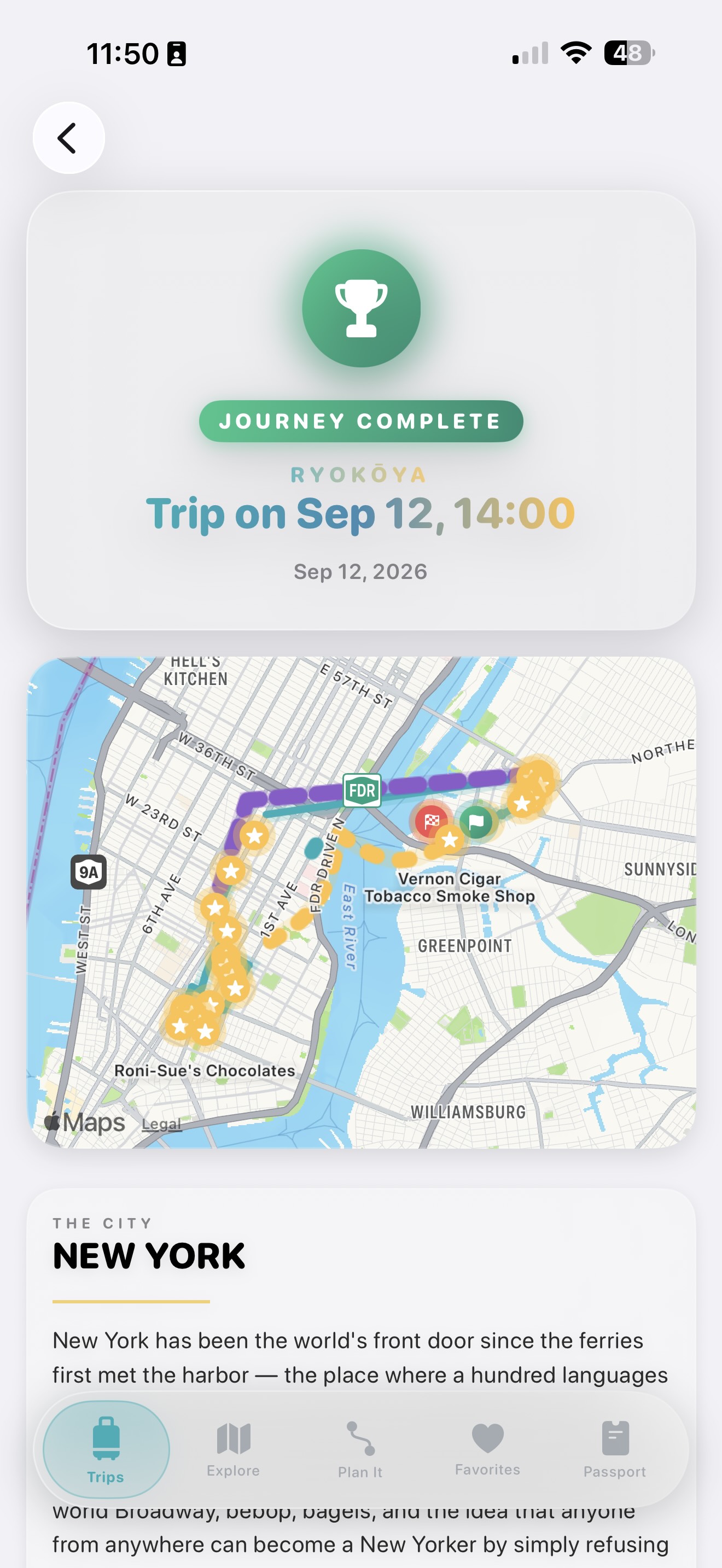
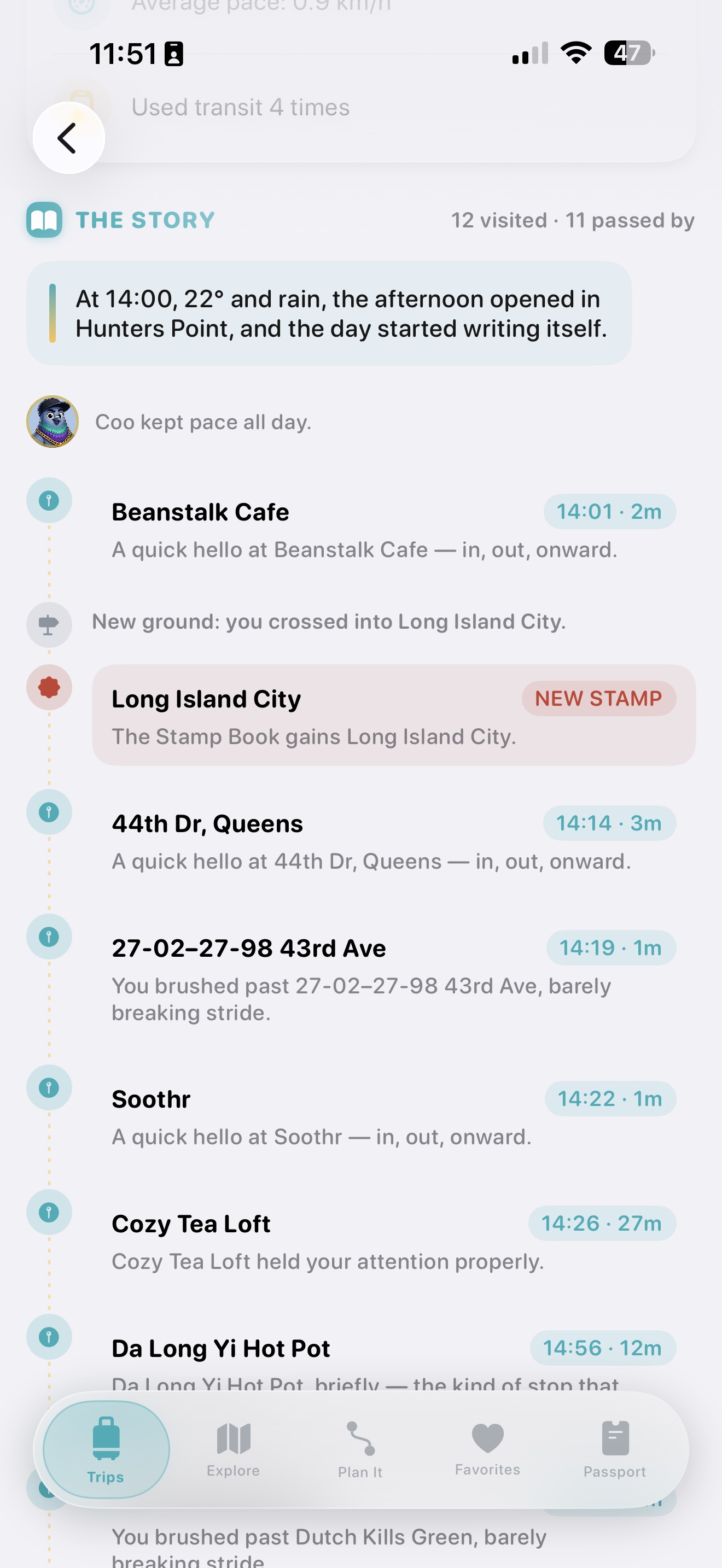
Ryokōya was built for that hour. You did not have to remember, because it was remembering — every stop, how long you stayed, the walk that joined them, and the weather while you were out there. The blue door has a name now, an address, and the photograph you took of it.
It also does the tedious half for you: the places you stopped at are saved as you go, so “where was that place?” is a list you already have rather than an evening spent scrolling backwards through a map.
Start a trip to record your day. Place detection can need a correction; automatic photo matching is a Pro feature.
An example day, handed back
Tuesday · Lisbon
6.8 km · 4 neighborhoods · 11,240 steps · 24°
That last one is the blue door.
Alfama Jul 28
The journal
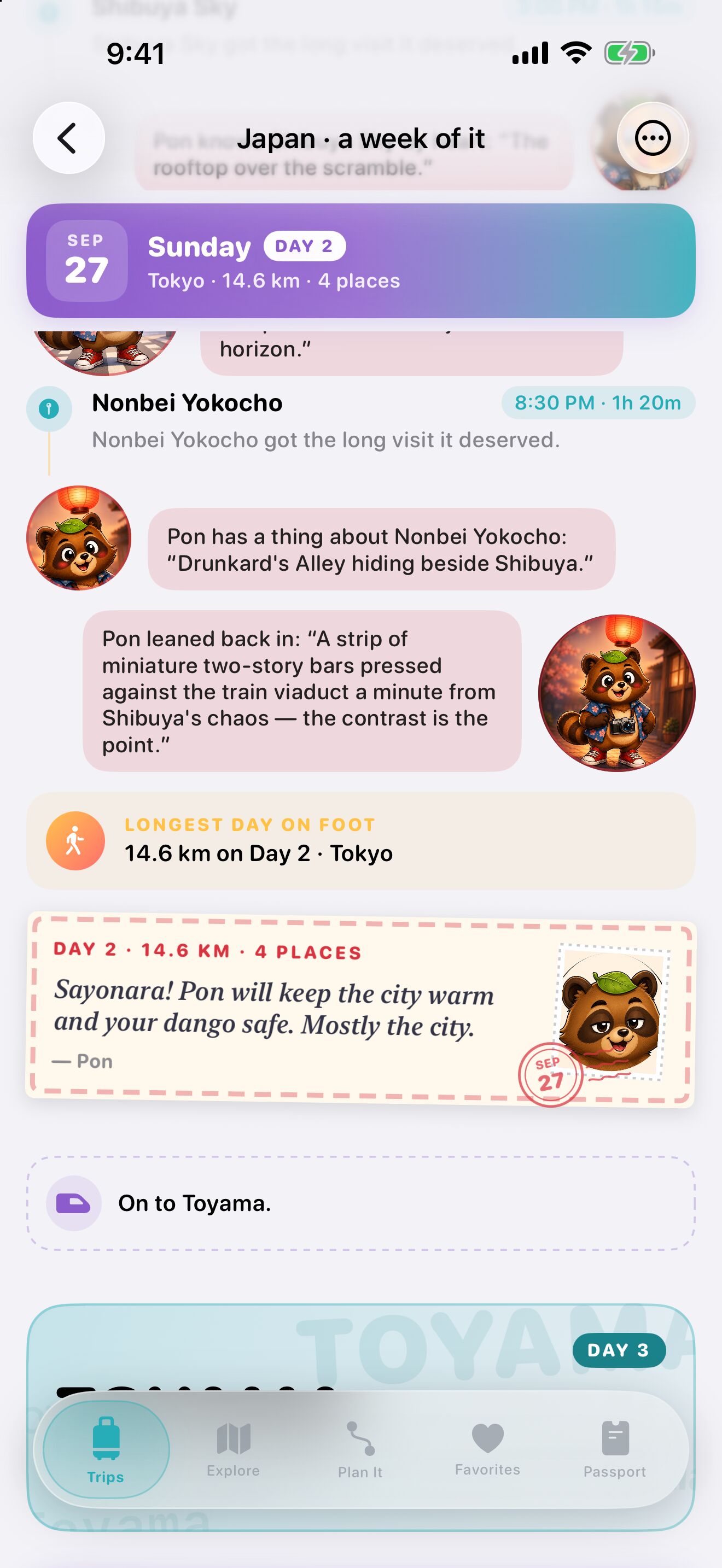
A week in Japan is seven trips: one started at the hotel door each morning, one ended each night with your shoes off. By the flight home, Ryokōya has noticed that they belong together, and one tap turns the week into a journey. One map holds every walk and the trains between the cities. Your totals and records come with it. And the days are there in order, each under its own band — Sunday, day 2, Tokyo, 14.6 km, four places — with the weather you walked through.
You are not reading it alone. Every city has a RyokōMate, and in Tokyo it is Pon, a tanuki with a leaf on his head and opinions about dango. Pon drops in between your stops the way a friend who lives there would. At Nonbei Yokocho he leans in with what the locals know: a strip of tiny two-story bars pressed against the train viaduct, a minute from the chaos of Shibuya. He has a word of the day, a story for the neighborhood you just crossed, something to say when it rains, and something else when you are out past the last train.
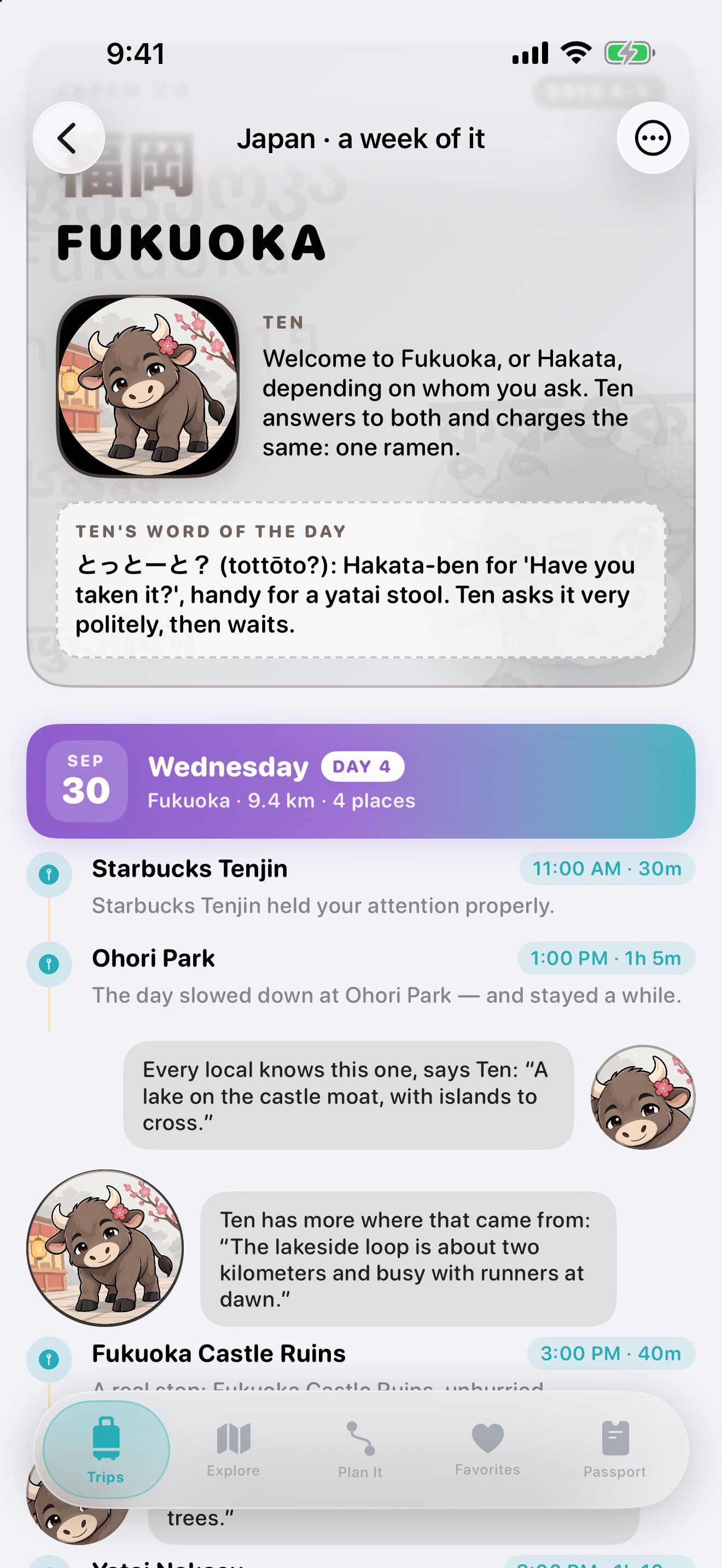
Every day ends on a postcard. Sayonara! Pon will keep the city warm and your dango safe. Mostly the city. Then the next city opens like a chapter in a book: its name in its own script, over its name in many languages, and a new RyokōMate waiting at the door. In Fukuoka that is Ten, one of the bronze oxen of the Dazaifu shrine, with a welcome and a word of the day — とっとーと?, Hakata dialect for “is this one taken?”, which is all the Japanese a yatai stool requires.
There are 4,227 lines like these across the 51 cities, each in its own RyokōMate’s voice, and every fact among them was checked against a source before it shipped. The jokes were not checked. Pon maintains they are all true.
And the week goes where you want it: into one book, printed the way the journal tells it, and into one favorites collection with every place you stood.
Journeys and the journal are free. A RyokōMate’s place stories come from its city’s free pack and the packs you own; exporting a book as a PDF is a Pro feature.
What you bring home
By then the trip has flattened out. The photographs are in the roll somewhere between a boarding pass and a cat. What most of us can offer is enthusiasm and a shrug — there was a place near the station, tiny, incredible, I never got the name.
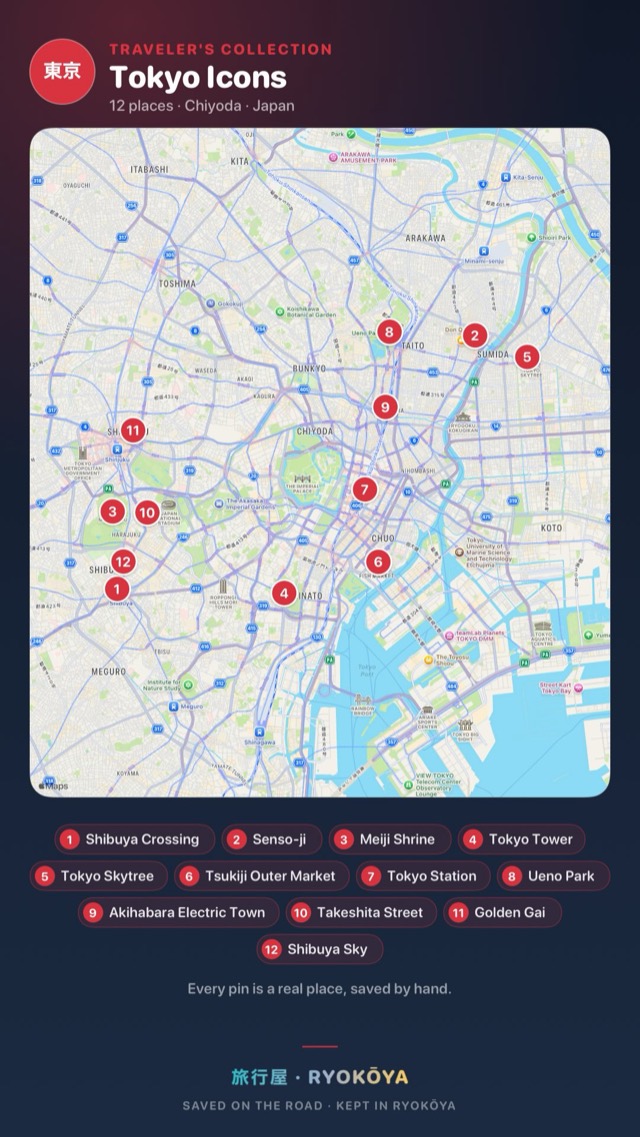
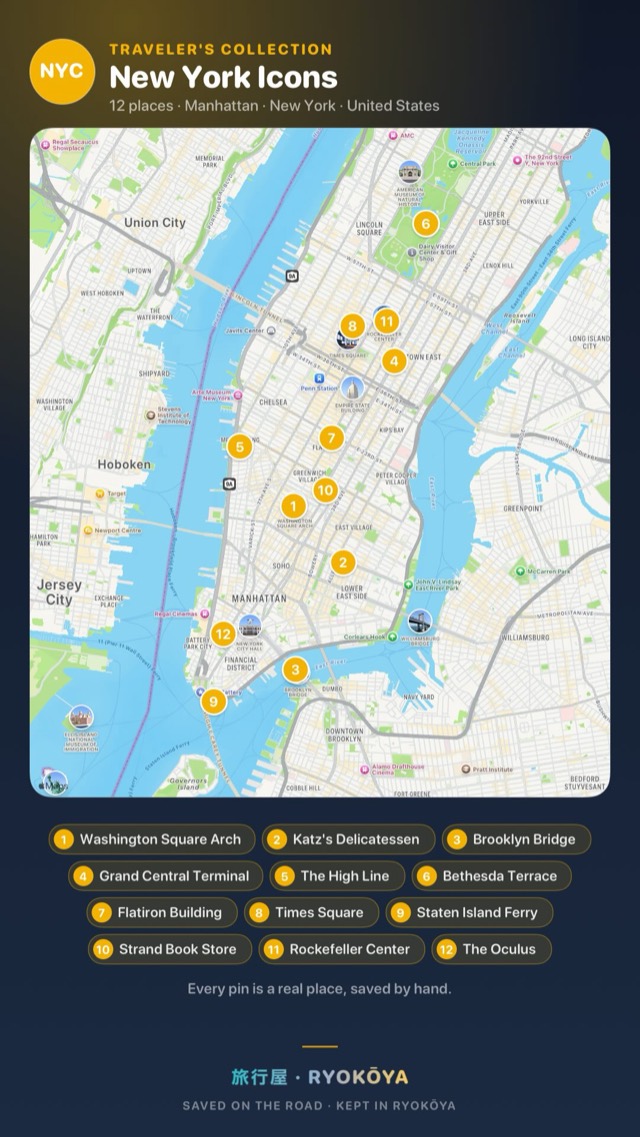
You have the map. Every stop from that trip was gathered into a collection while you walked it, with the city's name on the front and the places in the order you found them. Not the ones you meant to go to. The ones you went to.
It opens as a map rather than a list — pins where you actually stood, each one still carrying its name, its neighborhood, how long you stayed and the photograph you took there. Rename it, prune it, keep the eleven that mattered. It is yours to edit, and it does not expire when the trip does.
And it leaves whenever you want it to. Any pin opens in Apple Maps, Google Maps, or MapQuest for directions the next time you are standing nearby. The whole collection goes to whoever asked — as a card like these two, as plain text they can read in a message, or as a file their own map app will happily swallow.
Which is the quiet part: a trip you can hand to somebody. Not a recommendation you half-remember, but twelve places you can vouch for, because you were standing on every one of them.
Less documenting. More discovering.
Open Ryokōya before you set out. Give it the location permissions it needs, then put your phone in your pocket.
Follow your curiosity. Ryokōya records your route and detects your stops while you enjoy what’s around you.
Finish your trip and revisit the day as a journal. Add your own notes or correct a place. It’s your version of the day.
A little local inspiration
Find your way into it with themed collections of places. Coffee counters, quiet corners, a very good slice. Pick a pack and make an afternoon of it.

Coo · the rooftop pigeon
One more block.
One more good find.

Pon · the shapeshifting tanuki
Slow coffee.
Bright nights.

Gigi · the little gargouille
An unhurried seat.
A different view.
333 packs. 51 cities. A free starter pack in every one; more packs are one-time purchases, individually or in city bundles.
Walk a neighborhood and it is stamped in your Passport. Walk a city’s heart and win its crown.
Meet the RyokōMates
Every city has a RyokōMate who knows it: Coo the rooftop pigeon, Pon the tanuki, Rosa the flamingo, who judges you with one leg. Walk a pack’s places and its RyokōMate goes from silhouette to full color, then to gold when you finish. They tell your journal’s stories, serve your receipts, and keep score at Bingo.



















































Just for fun
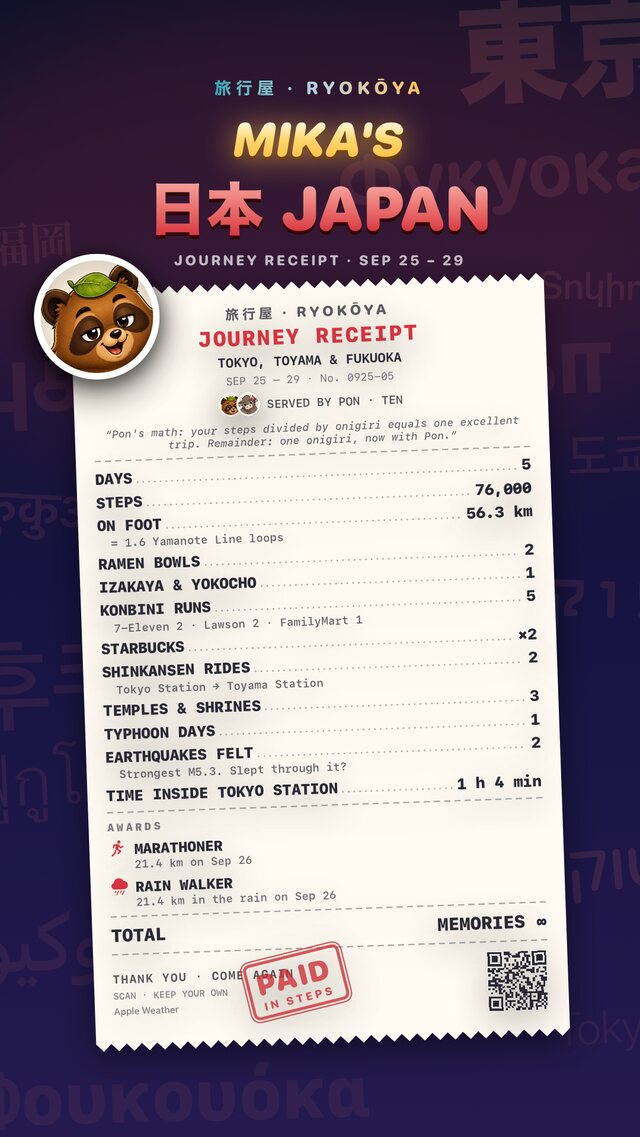
Somewhere between the airport and the last konbini, the numbers pile up, and Ryokōya keeps count. At the end of a trip, or of a whole journey, it hands them over the only way a trip should be itemized: as a receipt. Days and steps. Kilometers on foot, and how many laps of the Yamanote Line that makes. Ramen bowls. Konbini runs, split by chain. Shinkansen rides, station to station. Temples and shrines, typhoon days, an hour and four minutes inside Tokyo Station, and the earthquake you slept through.
Your RyokōMate does the math — your steps divided by onigiri equals one excellent trip; remainder: one onigiri, now with Pon — and the awards print underneath: Marathoner, Rain Walker, Konbini Connoisseur, Night Owl and six more. TOTAL: MEMORIES ∞. Pin the lines you love, drop the rest, roll the dice for another mix, and share it on the night sky or on a photo of your own.
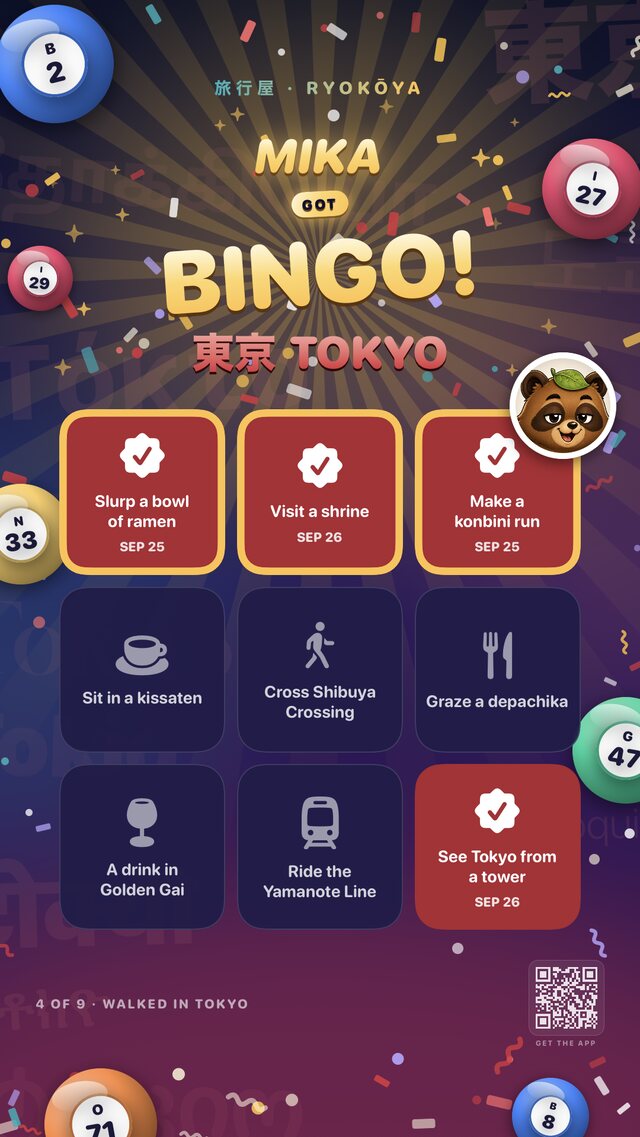
Every city also comes with a Bingo card: nine things to do there, checked off as you walk them. In Tokyo, slurp a bowl of ramen, sit in a kissaten, cross Shibuya Crossing, see the city from a tower. Three in a row is a BINGO, and a BINGO gets a card of its own.
The Playground on your Passport keeps all of it: a Bingo card for each of the 51 cities, every award you have won, and On This Day, the trips you took on this date in years gone by.
Receipts, Bingo and awards are free. A receipt’s earthquakes come from the USGS catalog: only the trip’s start and end times are sent, and which quakes were near you is worked out on your iPhone.
Start with a walk
Ryokōya
Record your days without a trip limit or a subscription.
Ryokōya Pro
For your photos, your backups, and the journeys still to come.
City packs are separate from Pro and Trip Pass. Current prices are shown in the app for your region.
Your travels. Your business.
Your trips live on your iPhone. With Pro, you can choose to back them up in your own iCloud. There’s no Ryokōya server holding your travel history.
No advertising trackers. No selling your data. You decide what to share, and with whom.
Read our privacy policyBefore you head out
You can record trips, routes, and stories beyond the City Pack destinations. City Packs and neighborhood stamps both cover 51 cities. Place detection depends on location signal and available place information.
Ryokōya requires iOS 26.2 or later and is designed for iPhone. The app is currently in English. Check the App Store listing for compatibility with your device.
No. Start a trip and put your phone away. With location access set to While Using the App or Always, and Precise Location on, Ryokōya keeps recording with your screen off. End the trip when you’re done. Places can occasionally be missed or named incorrectly; you can correct stops in your journal.
Background location uses battery, and conditions vary. See Support for permission and battery guidance.
Trip recording runs during a trip you start. An optional “Always Collecting” setting can recognize nearby owned pack places between trips; it is off by default and does not record a route. The privacy policy explains the distinction.
Yes. Your journals, journeys, favorites collections, Trip Receipts, Bingo cards, and share cards are part of the free experience. Trip books can be previewed for free; email stories, PDF trip-book export, and GPX route export are Pro features. In-app hardcover ordering is not available yet.
The companions who live in Ryokōya, one for each of the 51 cities: Coo the rooftop pigeon in New York, Pon the tanuki in Tokyo, Gigi the gargoyle in Paris, and 48 more. They tell your journal’s stories, serve your receipts, and keep score at Bingo. Until version 1.2.0, they were called Tabitomo.
No. Every pack city has a free starter pack. Other packs and city bundles are one-time purchases, separate from Pro. Pro and the 30-day Trip Pass unlock additional app features, not the paid City Pack catalog.
Version 1.2.1 brings stamps redesigned like postmarks, with an icon for every neighborhood, finished trips you can set right stop by stop, a journal that keeps each trip’s local time, and a guide on every tab. Every release, back to the first, is on What’s new.
Something else on your mind? A real person can help.
Your next story starts outside.
For iPhone · Free to start